Playbook
Texting for Women’s Health and Pregnancy Care Clinics
Women’s health clinics, OB-GYN practices, and pregnancy care providers are increasingly using HIPAA-compliant text messaging software to improve patient communication, reduce no-shows, and save staff time.
Communication plays a critical role in women’s health and pregnancy care. Patients aren’t just seeking medical advice—they’re looking for support through some of life’s most significant transitions.
That’s why it’s crucial to bridge the communication gap between patients and your clinic staff, especially when a patient is already managing things like a career, family, or physical demands of pregnancy.
In this women’s health and pregnancy care clinic playbook, we’ll guide you through how text messaging actually works for you, where it makes the biggest impact, and how to implement it without overwhelming your staff.

Why Women’s and Pregnancy Care Clinics Need Text Messaging
Patients prefer fast, convenient communication that already fits into their daily routines. Texting is the answer—as long as it’s done securely.
Phone tag, a full voicemail inbox, and emails can easily stagger important communication, but HIPAA-compliant texting helps create a more accessible and responsive patient experience, while also streamlining your day-to-day operations.
Women’s care clinics can use business texting to:
Simplify patient communication across multiple stages of care
Reduce missed calls and voicemail backlogs
Support busy front desk and administrative teams
Centralize patient conversations in one place
Create a more modern patient experience
HIPAA-compliant text messaging platforms like Text Request help women’s and pregnancy care clinics do all of these things—and more.

Is Texting HIPAA-Compliant for Women’s Health Clinics?
Yes, texting can be HIPAA-compliant when women’s health clinics and pregnancy care providers use a secure texting platform. It needs to meet the security, governance, and operational requirements specified by the Health Insurance Portability and Accountability Act, and other associated regulations.
Standard SMS texting from a personal device or basic messaging apps is not secure and does not meet HIPAA requirements.
To stay compliant, women’s health clinics and pregnancy care providers require a business texting platform that offers:
End-to-end encryption
Secure data storage
Access controls and user permissions
Audit trails
A signed Business Associate Agreement (BAA)
Text Request offers HIPAA-Compliant Texting accounts for primary care offices and other healthcare-related organizations. All data is permanently recorded, encrypted in transit and at rest, and our security is certified by third party auditors. We’ll even sign a Business Associate Agreement (BAA) with you upon request. Check out our security page to learn more.
Top 8 Texting Use Cases for Women’s and Pregnancy Care Clinics
1. Text appointment reminders and fill in scheduling gaps.
Text appointment reminders help women’s health and pregnancy care clinics reduce no-shows and ensure schedules stay full. Clinics can easily send automated reminders for important visits like:
Prenatal appointments
Ultrasounds
Annual wellness exams
Postpartum appointments
And more
Text messages are easily opened and read quickly, which makes patients more likely to confirm their appointments on time.

2. Guide patients through prenatal milestones with SMS updates.
Ongoing communication is crucial throughout the multiple stages of pregnancy care. Text messaging keeps patients informed with timely updates, reminders, and next steps throughout their pregnancy journey.
Women’s and pregnancy care clinics can use SMS updates to communicate:
Glucose screening reminders
Trimester transitions
Prenatal screening and labs
Immunization prompts
Any follow-up care instructions
Staying informed and engaged throughout pregnancy is crucial for helping patients feel supported. Texting is one of the best ways to do that.
3. Stay connected after visits with proactive postpartum check-ins.
The weeks following delivery are critical, and often when patients feel the most disconnected from their providers. Sending patients an automated check-in text is a simple way for pregnancy clinics to:
Follow up after delivery
Monitor recovery and mental health
Detect early signs of potential complications
Build lifelong loyalty
Reduce “new parent” phone tag
Using SMS to stay connected after delivery is a great way to strengthen patient relationships while helping clinics provide more responsive postpartum care.
4. Simplify patient intake with digital forms and paperwork reminders.
The first visit for any women’s health clinic usually involves extensive paperwork. But that can easily derail your schedule if a patient arrives unprepared.
Instead of leaving patients to find the forms on your website, text them the direct link at least 24 hours before their appointment. Patients can complete their history, consent, and insurance info on their own time.
More specifically, texting enables patients to:
Send a photo of their ID and insurance card
Check in upon arrival
Digitally sign any missed documents
The goal is to have the administrative work finished by the time the patient arrives. This allows your staff and providers to focus entirely on clinical care, resulting in a more relaxed and professional patient experience.
5. Quickly communicate scheduling changes and office updates.
Your ability to communicate at scale is a lifesaver for your staff and your patients, and mass texting blasts help you do that in real time.
Clinics can use mass texting to handle unexpected events, such as:
Last minute scheduling changes
Weather closure and delays
Parking or construction updates
Recall notifications on any related supplements or equipment
Local outbreaks in your area
Texting isn’t just for scheduling. It’s designed for real-time advocacy to ensure your patients are never the last to know.
6. Improve patient engagement with educational updates and care reminders.
Patient engagement shouldn’t stop once patients leave your clinic. Texting ensures patients get expert-backed advice at the right time, directly on their phone. The gaps between appointments are when patients often find themselves turning to unreliable online sources for health advice.
Your women’s health center can use texting to drive patient engagement by texting:
Medication and supplement reminders
Direct links to your medical resource library
Birth plan preparation
Support group invites
You want to be a health partner for your patients throughout their journey. Providing value between visits is a great way to build trust and ensure that patients reach out to you, and not a search engine.
7. Send secure SMS payment links to settle balances.
HIPAA-compliant text messaging platforms like Text Request make it easier for clinics to send secure payment reminders and SMS payment links directly to patients.
Clinics can use text-to-pay to improve their bottom line by sending:
Secure links for outstanding co-pays
Recurring payment reminders
Pre-appointment deposit requests
Payment links for missed appointment fees
Links to any supplies a patient may need to purchase, like prenatal vitamins, nursing supplies, or 4D ultrasound packages
When you make it easy to pay, patients pay faster. Text-to-pay links are typically settled sooner rather than waiting for the standard 30-day billing cycle.
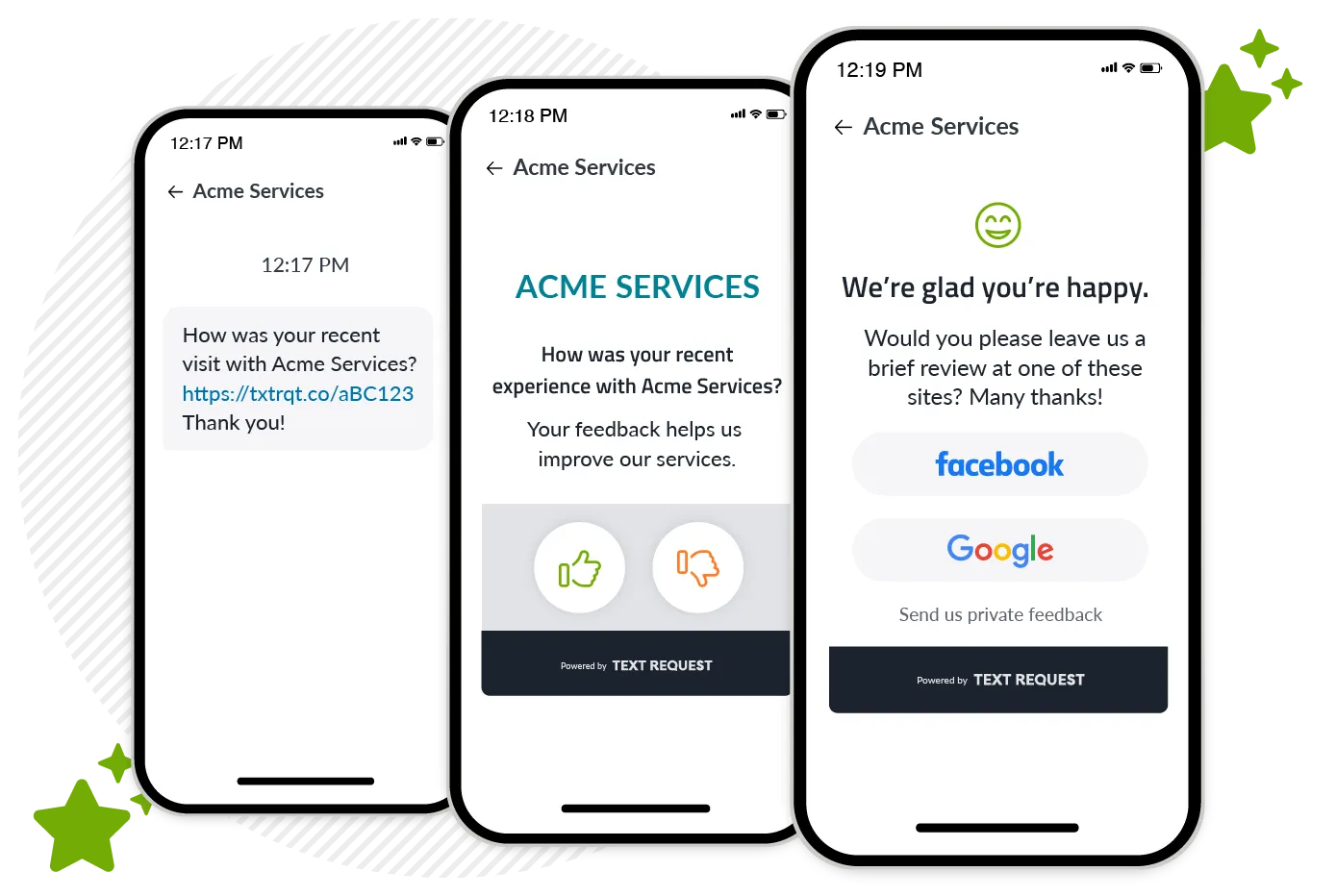
8. Grow your online reputation with review request texts.
Most patients choose a women’s health clinic based on local search results and patient testimonials. Your online reputation is your most powerful marketing tool, and texting leverages this by making the review process a breeze.
Clinics can boost their online presence by:
Sending automated post-visit review requests
Providing direct links to your review pages
Capturing the most impactful testimonials after a major milestone
Using a steady stream of 5-star reviews to signal a consistent care standard
Switching from email review requests to text review requests is a great way to rapidly increase your clinic’s review count. Higher ratings lead to better local visibility, so when patients search for “best pregnancy clinic near me”, your name is likely to be at the top of the results page.
10 Key Features to Look for in Women’s Health Texting Software
1. HIPAA-compliant messaging & security are essential for protecting patient data.
Look for a platform that offers a signed Business Associate Agreement (BAA) and end-to-end encryption—that's non-negotiable. That way, you can securely send text messages, images, PDFs, and Protected Health Information (PHI). In women’s health, you’re typically handling sensitive PHI and images, and secure software ensures you stay compliant while offering a modern patient experience.
2. Automated and scheduled messaging helps maintain consistent prenatal and postpartum touchpoints.
High quality business texting software allows you to set up recurring messages for the entire 40-week pregnancy journey. This helps ensure consistent patient engagement without extra manual effort from your staff.
3. Two-way messaging enables real-time support for expectant mothers and nervous patients.
The pregnancy journey comes with a lot of quick questions. Two-way texting enables patients to ask about symptoms, medication safety, appointment prep, etc while reducing the volume of inbound phone calls.
4. SMS Chat enables you to capture new patient inquiries.
An SMS chat widget enables you to capture inquiries directly from your website, whether it’s something like “Are you accepting new patients?” or “Do you take my insurance?”. From there, expectant mothers and other patients can continue the conversation on their mobile device—making it a powerful tool for patient acquisition.
5. A shared team inbox with user permissions keeps clinical and administrative communication organized.
A unified team inbox gives your front desk, billing, and nursing staff a seamless way to manage conversations in one place. A HIPAA-compliant texting software should offer granular user permissions—so staff can access the information they need without compromising overall patient privacy.
6. Group messaging and segmentation make it easier to reach the right patient cohorts all at once.
Look for healthcare texting software that enables you to group patients by criteria, such as “Due in October” or “High-Risk Prenatal”. Your mass texting campaigns will be more relevant and effective when you segment your patients into their corresponding cohorts.
7. Integrated payment and billing links help accelerate your clinic’s revenue cycle.
Billing in women’s health can be complex between co-pays and delivery fees. SMS payments make it easy for patients to settle balances or pay ahead of time for boutique services, such as 4D ultrasounds.
8. Integrations with your current EHR/EMR systems keep patient charts accurate and updated.
Your texting platform should work alongside popular systems like Athenahealth, eClinicalWorks, or Epic. Syncing the two is essential for ensuring contact information is always updated and every text conversation is logged in the patient’s medical chart.
9. Pre-written text message templates ensure consistency and professional communication.
Text message templates are a lifesaver in common scenarios like “What to bring to the hospital” or “Glucose test instructions”. This helps your team respond faster while maintaining a warm, professional, and consistent tone across your entire practice.
10. Review request tools to help grow your clinic’s reputation and attract new families.
A robust platform allows you to text direct links to Google after a positive milestone, like a 20-week anatomy scan. Review management tools help you automate this process, so you can dominate local search results and grow your practice via social proof.

8 Best Practices for Women’s and Pregnancy Care Texting
1. Prioritize HIPAA-compliant patient opt-in and opt-out.
Women’s health clinics should always obtain patient consent before sending text messages. This isn’t just a courtesy, it’s a requirement for HIPAA, TCPA, and 10DLC compliance. Collect consent via your intake forms and provide a clear exit option by letting patients know they can opt out at any time by texting “STOP”.
2. Keep text messages short, supportive, and actionable.
Texting is most effective when it’s concise. Every text should have a clear next step, such as a link to a secure portal, a confirmation request, or a specific instruction (e.g. “Arrive with a full bladder). That way, you reduce confusion while creating a more supportive patient experience.
3. Use clinical templates to save time and ensure consistency.
Respond instantly with pre-written text message templates. Saved message templates help your staff respond more efficiently without sacrificing accuracy.
4. Respond promptly to reduce patient anxiety.
In women’s health and pregnancy care, patients often have time-sensitive questions or concerns. A quick response can be the difference between a panicked phone call and a relaxed patient. Timely replies keep your phone lines open for emergencies and prevent a backlog of voicemails. The faster you respond to your patients, they’re more likely to stay with your practice for the long term.
5. Personalize communication to build and reinforce a caring partnership.
Pregnancy is deeply personal, and your communication should reflect that too. Small personalization touches like using a patient’s name or referencing an upcoming appointment helps make communication more relational and human rather than transactional.
6. Be mindful of Protected Health Information (PHI).
Clinics should avoid sharing unnecessary sensitive information via SMS—even if you’re using a HIPAA-compliant platform. Your staff should know to use texting solely for logistics, reminders, and check-ins. If patients want to delve into deeper medical conversations, direct them to your secure EMR/EHR patient portal for detailed lab results or specific diagnostic discussions.
7. Establish clear boundaries for non-emergency texting.
Manage patient expectations by clearly stating that your texting line is intended for non-urgent communication. Clinics like yours can use automated responses or onboarding messages to explain response times and emergency communications procedures.
8. Train your staff on appropriate texting etiquette.
A unified administrative and clinical team is highly respected and enforces trust with your patients. Train staff to follow established workflows and use professional but empathetic language. Most importantly, ensure your team knows how to document these conversations into the patient’s medical chart to maintain a complete history of care.
How to Implement Text Messaging in Your Women’s Health Practice
1. Secure a HIPAA-compliant text messaging platform.
Your first step is to select a HIPAA-compliant platform. Text Request supports secure patient messaging and allows you to create scalable communication workflows.
2. Automate your most repetitive patient communication touchpoints.
Identify the communication tasks that take up the most staff time or create the most patient friction.
Many women’s health clinics start with:
Prenatal visit reminders
Clinical follow-ups
Billing notifications
Intake and paperwork reminders
Online review requests
3. Train your front desk and care teams on texting workflows.
Clear communication processes help teams manage patient conversations more consistently. Conduct a kickoff meeting with your team to define:
Who manages incoming patient texts
When conversations should be escalated to nurses or providers
How to sync conversations back to the patient’s chart in your EMR/EHR to maintain a complete medical history
How to handle sensitive patient communication appropriately
4. Promote your text line at every stage of the patient journey.
Patients need to know they have the option to text your practice. Growing your patient contact lists starts with making opt-ins easy by:
Adding “text us” options across your website
Including consent checkboxes on intake forms
Offering text communication during appointment scheduling
Placing “text us” signage in exam rooms and the check-out counter
5. Expand your features as your practice scales.
You don’t have to launch every texting feature on day one. Many women’s health clinics start with appointment reminders, and gradually expand into additional workflows over time.
Once your team is comfortable, layer in advanced features like:
Mass messaging
Review requests
Educational messaging
SMS Chat for your website visitors
Ready to Improve Communication with Text Request?
Strengthen patient communication throughout every stage of care with HIPAA-compliant text messaging designed for women’s health and pregnancy care clinics.
Text Request is here to help you bridge the communication gap between clinical excellence and daily convenience. Whether you’re managing a high-volume GYN schedule or supporting expectant mothers through every milestone, our team is here to help you build a texting strategy that makes sense for your clinic’s communication needs.
Schedule a demo today to speak with our experts about the use cases most important to your clinic’s success.

Common Women’s and Pregnancy Care Clinic Texting FAQs
1. Is text messaging HIPAA-compliant for women’s health clinics?
Yes—as long as you use a platform like Text Request that signs a Business Associate Agreement (BAA) and uses encrypted messaging. Texting is perfectly compliant for things like scheduling, care reminders, and general patient support.
2. How should women’s health clinics handle medical emergencies that come in via text?
Texting should only be used for non-emergency communication. Make sure you have an automated autoresponse active for after-hours or when your staff is unavailable. This message should clearly state: “If you are experiencing a medical emergency, please call 911 or on our 24/7 on-call line at [Phone Number].”
3. Can women’s health clinics text patients their ultrasound photos or lab results?
We recommend redirecting patients to their secure patient portals for PHI such as ultrasound photos, lab results, and more. You should still be mindful when sharing PHI, even when you’re using a HIPAA-compliant platform. It’s always best to err on the side of caution.
4. How can text messaging reduce patient no-shows?
Automated text message reminders help patients stay informed about upcoming appointments while making it easier to confirm, cancel, or reschedule visits before they’re missed.
5. What should women’s health clinics look for in texting software?
The most successful clinics prioritize security, integration, and automation. The best texting software for your clinic allows your staff to spend less time on the phone, and more time providing high-quality care your patients deserve.